
Your Garage Door Weighs 500 Pounds — Do You Know If It’s Safe?
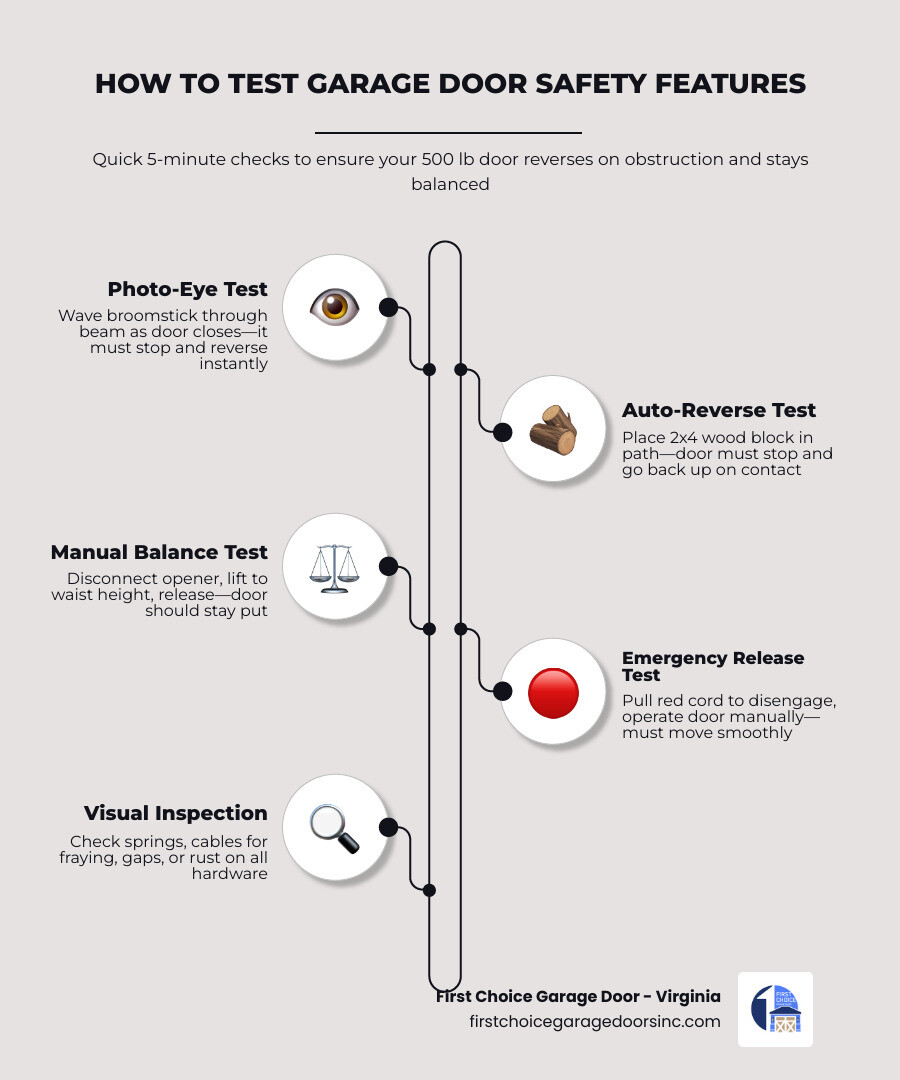
How to test your garage door safety features is something every homeowner should know — and the good news is it takes as little as five minutes. Here’s a quick overview of the core tests:
- Photo-eye sensor test — Wave a broomstick through the sensor beam while the door is closing. The door should immediately stop and reverse.
- Auto-reverse test — Place a 2×4 block of wood flat on the ground in the door’s path and press close. The door must stop and reverse on contact.
- Manual balance test — Disconnect the opener, lift the door to waist height, and let go. A balanced door stays in place.
- Emergency release test — Pull the red cord to disengage the opener, then open and close the door by hand. It should move smoothly.
- Visual spring and cable check — Look for fraying cables, gaps in springs, or rust on hardware.
Most modern garage doors weigh at least 500 pounds. Since January 1, 1993, federal law has required all residential automatic garage door openers to include safety reverse sensors and auto-reverse systems under the UL 325 standard. That means if your opener was made after 1993, these protections should already be built in — but only if they’re actually working.
A malfunctioning sensor or a door that won’t reverse isn’t just an inconvenience. It’s a serious safety hazard for children, pets, and anyone in the garage.
The tests above are simple, free, and take just a few minutes. The sections below walk you through each one in detail — including what to do if something fails.
Why Regular Safety Checks are Essential for Northern Virginia Homeowners
In Northern Virginia, we rely on our garage doors more than almost any other home feature. Whether you’re commuting from Manassas or navigating the busy streets of Northern VA, your garage door likely acts as your primary front door. In fact, research shows that 55% of homeowners use their garage as the main entryway to their home.
Because we use them so often, it’s easy to forget that the garage door is the largest moving part of your house. When you consider that most of these doors weigh upwards of 500 pounds, the stakes for safety become very clear. A failing safety feature isn’t just a mechanical glitch; it’s a risk to your family, your pets, and your vehicles.
Regularly learning how to test your garage door safety features helps with accident prevention and property protection. We recommend performing a quick “5-minute safety test” every single month. It might sound like a lot, but catching a frayed cable or a misaligned sensor today can prevent a catastrophic failure tomorrow. Understanding Why You Need to Perform Garage Door Inspections is the first step in maintaining a secure home environment.
Step-by-Step: How to Test Your Garage Door Safety Features
Testing your door doesn’t require a degree in engineering. You likely already have the “tools” needed in your garage: a cardboard box, a broomstick, and a scrap piece of 2×4 wood.
Before you begin, make sure the area around the door is clear. You want to ensure that if a test fails, you aren’t putting yourself or your property in immediate danger. Following these Garage Door Safety Tips to Follow will help ensure your testing process is as safe as possible.
How to Test Your Garage Door Safety Features: Photo-Eye Sensors
The photo-eye sensors are those little “eyes” located on either side of your garage door tracks, usually about 4 to 6 inches off the ground. They send an invisible infrared beam across the opening. If that beam is broken while the door is closing, the door should stop and reverse immediately.
The Obstruction Test:
- Open your garage door completely.
- Press the button to close the door.
- As the door begins to descend, wave a long object like a broomstick (or even your foot, carefully) through the path of the sensors.
- The door should instantly stop and move back to the fully open position.
If the door continues to close, you have a problem. Common culprits include dirty lenses (dust and cobwebs are notorious for this), misalignment, or faulty wiring. A quick wipe with a soft cloth can often fix “ghosting” issues. For more detailed troubleshooting, check out The Easton Guide to Fixing Garage Door Sensors and Tracks.
Testing the Auto-Reverse Mechanism
While photo-eyes catch things before they are hit, the auto-reverse mechanism is the secondary safety net that triggers when the door actually makes contact with an object. This is a federal requirement for all openers manufactured after 1993.
The 2×4 Test (The Industry Standard):
- Place a 2×4 piece of wood or a solid brick flat on the ground in the center of the garage door’s path.
- Press the close button on your remote or wall console.
- When the door strikes the wood, it must stop and reverse within two seconds.
If the door strikes the object and continues to exert downward pressure, your force settings may be too high, or the internal logic board may be failing. This is a critical safety failure. You can find more advice on this in our 5 Garage Door Safety Tips.
How to Test Your Garage Door Safety Features: Manual Balance and Release
A garage door shouldn’t rely solely on the motor to do the heavy lifting; the springs should do the “real work.” If the door is out of balance, the motor has to work harder, which leads to premature wear and potential safety risks.
The Halfway Lift Test:
- Close the door completely.
- Pull the emergency release handle (the red cord) to disconnect the door from the opener.
- Manually lift the door to about waist height and let go.
- Results: If the door stays in place or moves only slightly, it is well-balanced. If it slams shut or “shoots” upward, the spring tension is incorrect.
The Emergency Release Test: While the door is disconnected, move it all the way up and down by hand. It should move smoothly without grinding or sticking. If it feels heavy or makes popping sounds, your rollers or tracks might need attention. Understanding the Parts of a Home vs Professional Garage Door Inspection can help you decide when a DIY check is enough and when you need expert help.
Troubleshooting Common Safety Sensor and Component Issues
When your safety tests fail, it’s usually due to a few common issues. Sensors are particularly finicky. Because they are located so close to the ground, they are prone to being bumped by trash cans, bikes, or lawnmowers.
Sensor LED Light Meanings:
| Light Color/Status | What it Usually Means |
|---|---|
| Solid Green/Amber | Sensors are powered and aligned. |
| Blinking Light | Sensors are misaligned or blocked. |
| No Light | No power to the sensor (check wiring). |
Sunlight Interference: In Northern Virginia, we get some bright mornings. Sometimes, direct sunlight can “blind” the receiving sensor, making it think there is an obstruction when there isn’t. You can often fix this by creating a small “sun shield” out of cardboard or repositioning the sensors slightly further back into the shade of the tracks.
Wiring and Cables: Check for pinched wires or frayed lift cables. Since these cables support the full 500-pound weight of the door under high tension, any sign of fraying is an emergency. For more on keeping your system safe, read about Safety Measures to Take With an Automated Garage Door.
Frequently Asked Questions about Garage Door Safety
What should I do if the auto-reverse or photo-eye sensor tests fail?
If your door fails either of these tests, you should immediately stop using the automatic opener. Pull the red emergency release cord to operate the door manually until a professional can inspect it. A door that won’t reverse is a major liability, especially if you have children or pets.
How do I know if my garage door springs are worn or dangerous?
Look for a visible gap in the coils of your torsion spring (the large spring above the door). Other signs include loud “bangs” coming from the garage, the door moving very slowly, or the door appearing crooked in the tracks. Never attempt to adjust or remove garage door springs yourself; they are under extreme tension and can cause severe injury.
Are older garage doors required to have these safety features?
While federal law mandated these features for all openers manufactured after January 1, 1993, many older homes in Northern Virginia still have legacy systems. If your door lacks photo-eyes or an auto-reverse mechanism, we strongly recommend a retrofit or a full opener replacement to bring your home up to modern safety standards.
Conclusion
Your garage door is a convenience, but it is also a heavy piece of machinery. Taking five minutes every month to learn how to test your garage door safety features is one of the best ways to protect your home and loved ones. From checking the photo-eyes to ensuring the springs are balanced, these simple steps provide peace of mind.
At First Choice Garage Doors, we’ve spent years serving the Northern Virginia and Manassas communities. We pride ourselves on unmatched expertise and a commitment to safety. If your door fails any of these tests, or if you simply want a professional to perform a comprehensive 25-point inspection, we are here to help.
Don’t wait for a small squeak to turn into a 500-pound problem. Contact us today to schedule your Garage Door Maintenance and ensure your home remains safe and secure for years to come.